
Protect
“Many people ask me what it is we can do to help our environments… I think the answer to that is real simple, just leave them the hell alone.” – Bernie Krause
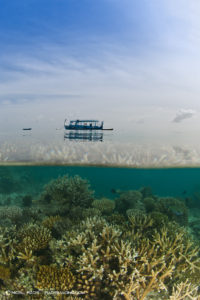
The direct and indirect human impact on coral reefs has been well documented in recent years. As one of the most diverse and threatened ecosystems on the planet, protecting coral reefs is an urgent conservation priority. Yet this is easier said than done. Whilst it is possible to tackle some of the direct pressures on reefs – overfishing and destructive fishing practices, pollution, wastewater, excessive tourism – what about the effects of climate change i.e. the warming and acidification of the oceans? How can we begin to tackle these seemingly insurmountable problems?
But there is hope. There have been some remarkable advances in recent years in terms of the number and scale of Marine Protected Areas created to protect swathes of our oceans which are high in biodiversity and / or susceptible to Illegal and Unreported Fishing (IUU). There are also many much smaller, more local approaches to coral reef protection such as Locally Managed Marine Areas (LMMAs) or Marine Conservation Agreements (MCAs), many of which are proving to be hugely beneficial, both to coral reef health and biodiversity, but also to the communities that depend on them.
Learn about some of the organisations we believe are making a difference
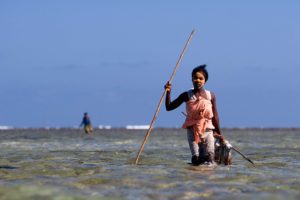
Blue Ventures
Over 10 years ago, Blue Ventures began surveying coral reefs in the Mozambique Channel off the southwest coast of Madagascar. Like many other reefs around the world, the Gran Recife suffers from the combined effects of warming oceans and severe pressure from local impacts, particularly over-fishing. Realising that degraded coral reefs were just one part of a much bigger puzzle, Blue Ventures began working with small fishing communities to try to improve fishing yields by implementing targeted local closures of small marine areas to give reefs time to recover and replenish fish stocks.
This initial experiment was so successful that many other villages and communities up and down the coast began asking for help to set up their own targeted closures.
One of the most valuable lessons from Blue Ventures’ work is the importance of taking a holistic view of conservation, understanding that coral reefs are important to different people for a variety of reasons. As scientists, the goal is of course to conserve and protect corals and their biodiversity, but in one of the poorest communities on the planet, their value as a resource needs to be acknowledged. The process by which Blue Ventures has developed its model and gained the trust and participation of communities shows the value of involving all stakeholders in any efforts to protect ecosystems.
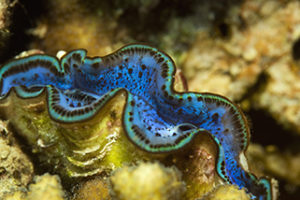
OneReef
The mission of OneReef is to protect coral reefs across Micronesia and help to ensure both that the reefs remain healthy and retain their biodiversity, but also that the communities living alongside them are able to thrive and use them sustainably. Many of the reefs in the region have so far escaped some of those most harmful direct human impacts affecting other reefs in more populous parts of the ocean, so the work of OneReef is vital to increase their resilience to the more widespread problem of global warming and ocean acidification.
The OneReef model aims to link local communities to global investors in order to provide the resources and skills needed to develop community-driven protection through a series of Marine Conservation Agreements. These agreements are designed to be long-term commitments – usually 20 years – and scalable. OneReef has developed these MCAs at 4 sites, spanning some 350,000 acres in Micronesia, and their goal is to grow this to 1 million acres by 2018.
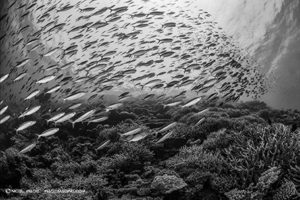 Wildlife Conservation Society
The Wildife Conservation Society (WCS) is working to empower Kenyan communities in sustainably managing their fisheries and protecting coral reefs.
Kenya’s coastal ecosystems are diverse and economically important. They support activities such as fishing and tourism, and coral reef and seagrass habitats that act as feeding grounds for endangered species including sea turtles and marine mammals.
The Wildlife Conservation Society (WCS) has been active in Kenya for almost two decades, led by Dr Tim McClanahan, one of the world’s leading coral reef scientists. Its long-term presence has allowed it to build up trusted relationships with small-scale fishermen (who represent 80% of Kenyan fishers), government agencies, and other stakeholders, as well as develop a long-term monitoring programme, something that is rare in tropical countries.
WCS Coral work in the Western Indian Ocean